

NEW PUBLICATION: Embedded 3D Printing of Graphene-Oxide-Rich Hydrogels for Advanced Biomedical Interfaces
Researchers from i3S – Instituto de Investigação e Inovação em Saúde, along with collaborators from MERLN Institute (Maastricht University), have published a new research article in Small Science that showcases how an innovative embedded 3D printing approach can be leveraged to process hydrogels containing high concentrations of graphene oxide for advanced biomedical uses.
The study, titled “Embedded 3D Printing of Graphene Oxide-Containing, Chemically Crosslinkable Poly(Ethylene Glycol) Inks”, explores how graphene oxide (GO) can be incorporated at high loadings (4% w/v) into poly(ethylene glycol) (PEG) hydrogels and successfully shaped into complex three-dimensional constructs using an embedded printing strategy.
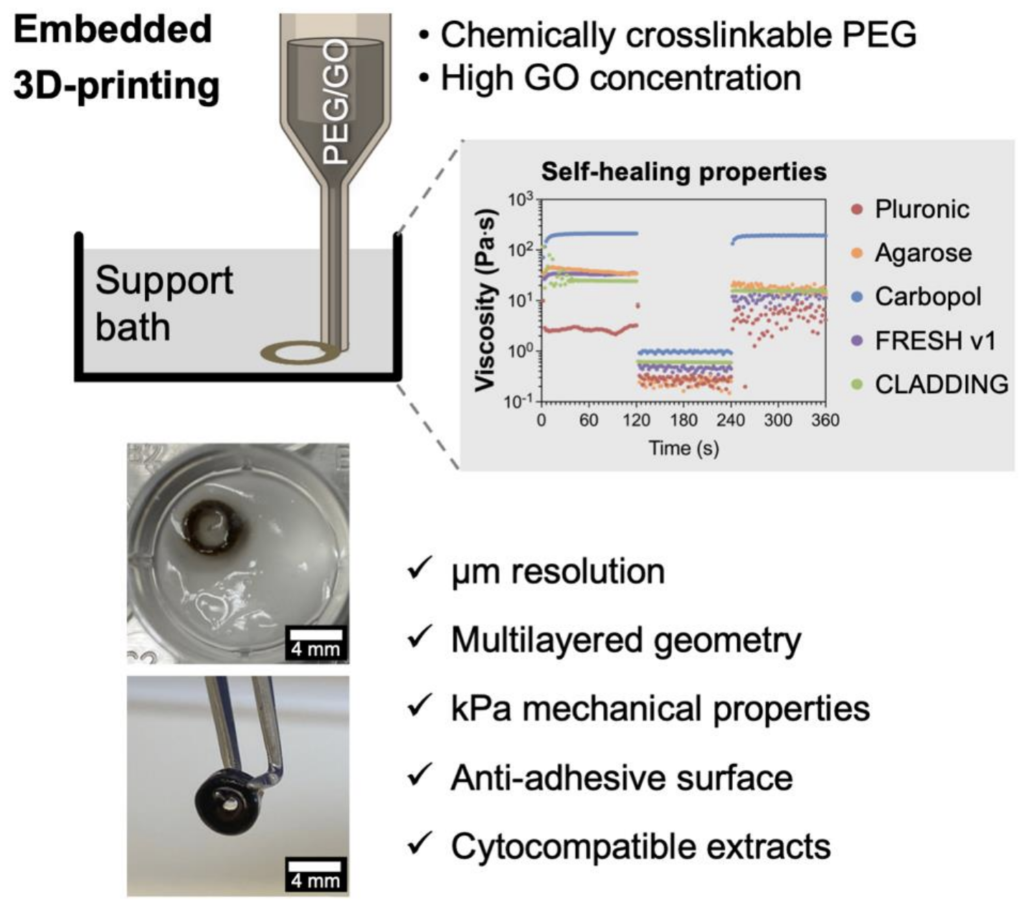
Graphene-based materials can significantly enhance the mechanical strength, electrical conductivity, and antimicrobial properties of hydrogels, making them attractive for biomedical applications. However, high GO concentrations often hinder shape retention and photocrosslinking in traditional printing approaches. To address this, the team screened support baths and identified a crystal self-healing embedding bioprinting (CLADDING) bath that effectively supports embedded printing of the PEG/GO ink with high fidelity and stable multilayered geometries.
The work demonstrated that 3D-printed GO-rich constructs can achieve sub-millimeter filament widths and multilayer architectures, with enhanced stability and tensile properties. Moreover, the printed structures showed cytocompatibility and anti-adhesive surfaces, broadening their potential for applications requiring kPa-range mechanical properties and complex shapes.
Ferreira et al. highlight a significant advance in biomanufacturing strategies for graphene-containing biomaterials and open new avenues for using high GO content hydrogels in tissue engineering, soft robotics, and other biomedical fields. The work contributes to ongoing efforts within the Blood2Power project to develop advanced functional materials for biomedical applications.
Authors: Helena P. Ferreira, Monize C. Decarli, Duarte Moura, Rúben F. Pereira, Andreia T. Pereira, Lorenzo Moroni, and Inês C. Gonçalves.
The paper is available open access in Small Science at https://doi.org/10.1002/smsc.202500278.
Deixe um comentário