

NEW STUDY Shows How Vascular Graft Materials Affect Early Healing
A new open-access study published in Materials Today Bio reports distinct host responses to autologous and synthetic small-diameter vascular grafts during the early healing phase, with implications for the design of improved vascular prostheses. The article sheds light on how different graft materials interact with surrounding tissues soon after implantation, providing insights relevant for the development of next-generation biomedical devices.
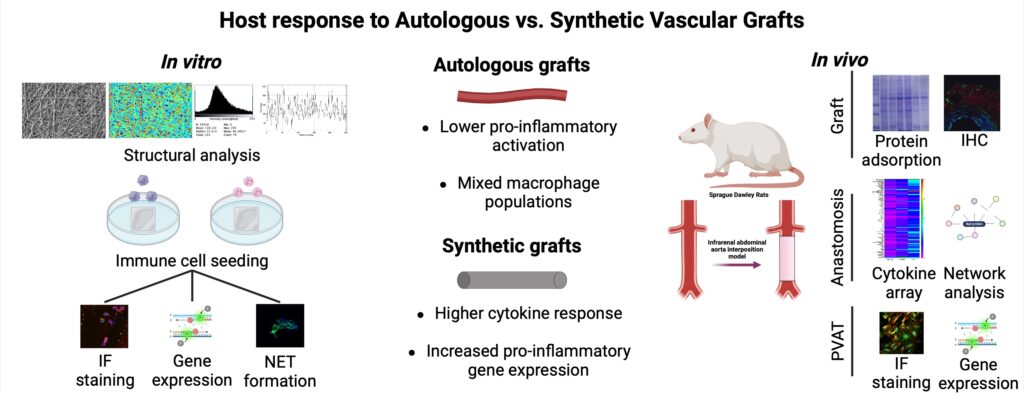
The choice of graft material plays a critical role in vascular surgery and tissue engineering, particularly for small blood vessels where long-term performance remains a challenge. Autologous grafts, taken from the patient’s own body, are commonly preferred due to their superior healing profiles, but synthetic alternatives are often needed when autologous options are unavailable. This study compared host responses to decellularized umbilical cord artery grafts (as a biologically derived model) and two types of synthetic grafts: biodegradable thermoplastic polyether‑urethane (TPU/TPUU) and expanded polytetrafluoroethylene (ePTFE).
Rohringer et al. evaluated how these materials influence inflammation and healing both in the anastomotic regions, where the graft is joined to the native vessel, and in the perivascular adipose tissue (PVAT), a key but often overlooked component of vascular healing. In vitro and in vivo experiments revealed that autologous grafts elicited minimal early inflammatory responses, while synthetic grafts, particularly ePTFE, triggered stronger activation of pro‑inflammatory cytokines and gene pathways shortly after implantation. TPU/TPUU showed a delayed but noticeable response.
Notably, analyses of PVAT also demonstrated significant inflammation in response to ePTFE, contrasting with limited activation around autologous and TPU/TPUU grafts, suggesting that the tissue surrounding the graft plays an important role in early host reactions. These insights underscore the importance of evaluating both direct graft–tissue interactions and the broader tissue environment to improve future vascular graft designs. Understanding early tissue responses is crucial to ensure long-term biocompatibility and reliable function of implantable devices.
The study, conducted by MUV team members Sabrina Rohringer, Anna‑Maria Schmitt, and Helga Bergmeister, is published in Materials Today Bio and is available open access at https://doi.org/10.1016/j.mtbio.2025.102089.
Deixe um comentário